
Last month, the mayor (finally) released audited enrollment data. But the report created by the office of the state superintendent of education (OSSE) is dated January. So let us examine some reasons for those months of silence.
–Enrollment is not demonstrably increasing. The total audited numbers this year (including adults) are 51,782 for DCPS and 48,065 for charters (versus last year: 52,299 for DCPS and 47,861 for charters—or 99,847 this year versus 100,160 last year).
The difference in total numbers between this year and last is not much (313)—and in fact total K-12 audited enrollment slightly increased (81,814 this year versus 81,750 last year). But kindergarten enrollment slightly decreased (7,210 this year versus 7,286 last year), and total pre-K enrollment decreased even more (11,663 this year versus 12,041 last year).
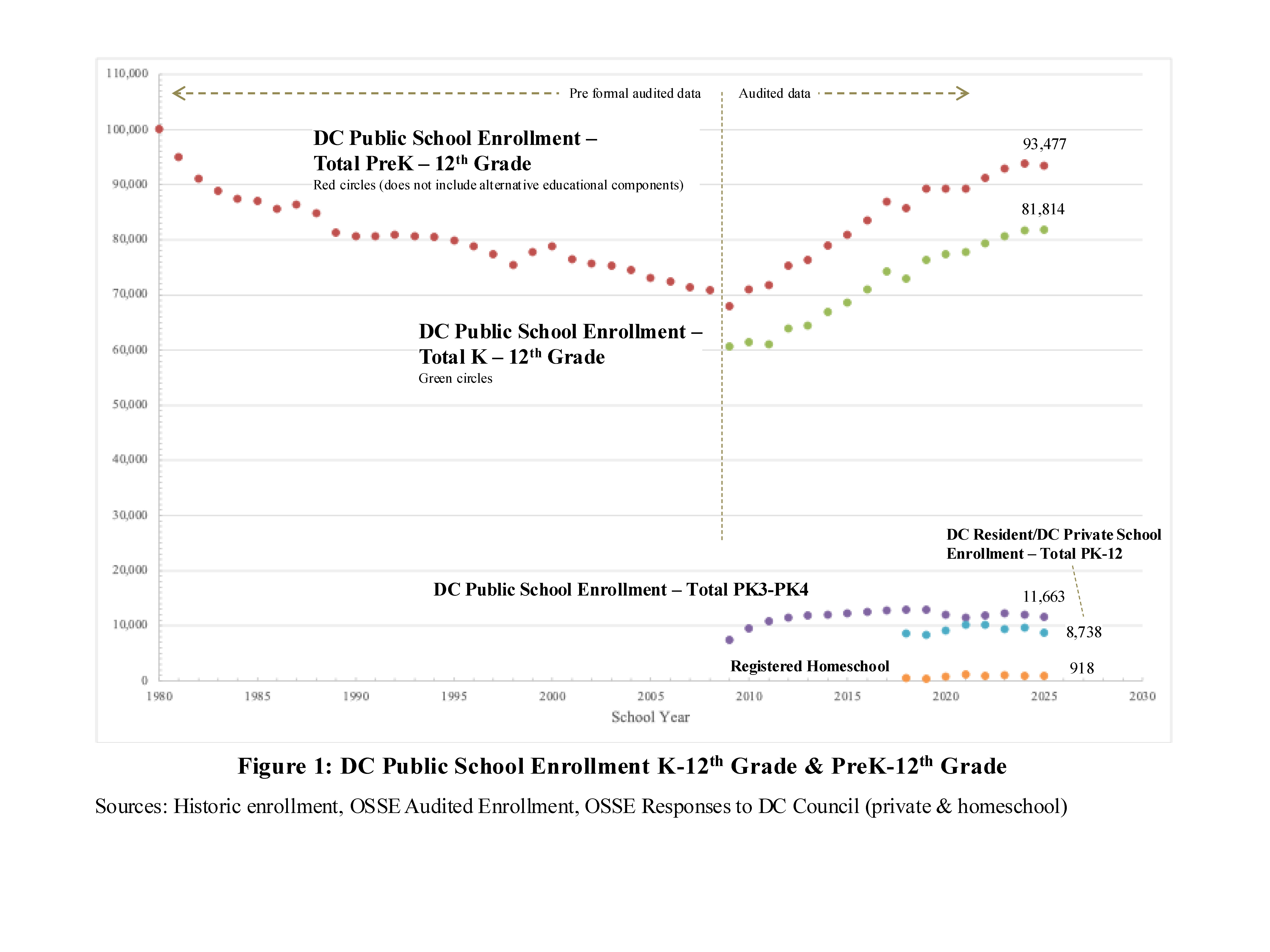
Whatever one thinks of those decreasing numbers at the lowest grades, steadily and obviously growing enrollments have long been regarded as evidence of the virtues of DC’s education governance. Thus, having enrollments demonstrably not grow (and even slightly decline) may seem like some sort of political repudiation.
But there is more.
–DCPS now has 55.9% of all K-12 students, the lowest during DC’s charter era (AD 1996). That said, it is not much different from recent years, as DCPS has been below 57% of total enrollment since SY17-18. Nonetheless, it is unsettling for a system of mayoral control to have the city-wide system steadily lose students and (as the ed reformers like to say) market share.
And then, as they say, the bottom drops out.
–DC births are absolutely not increasing.
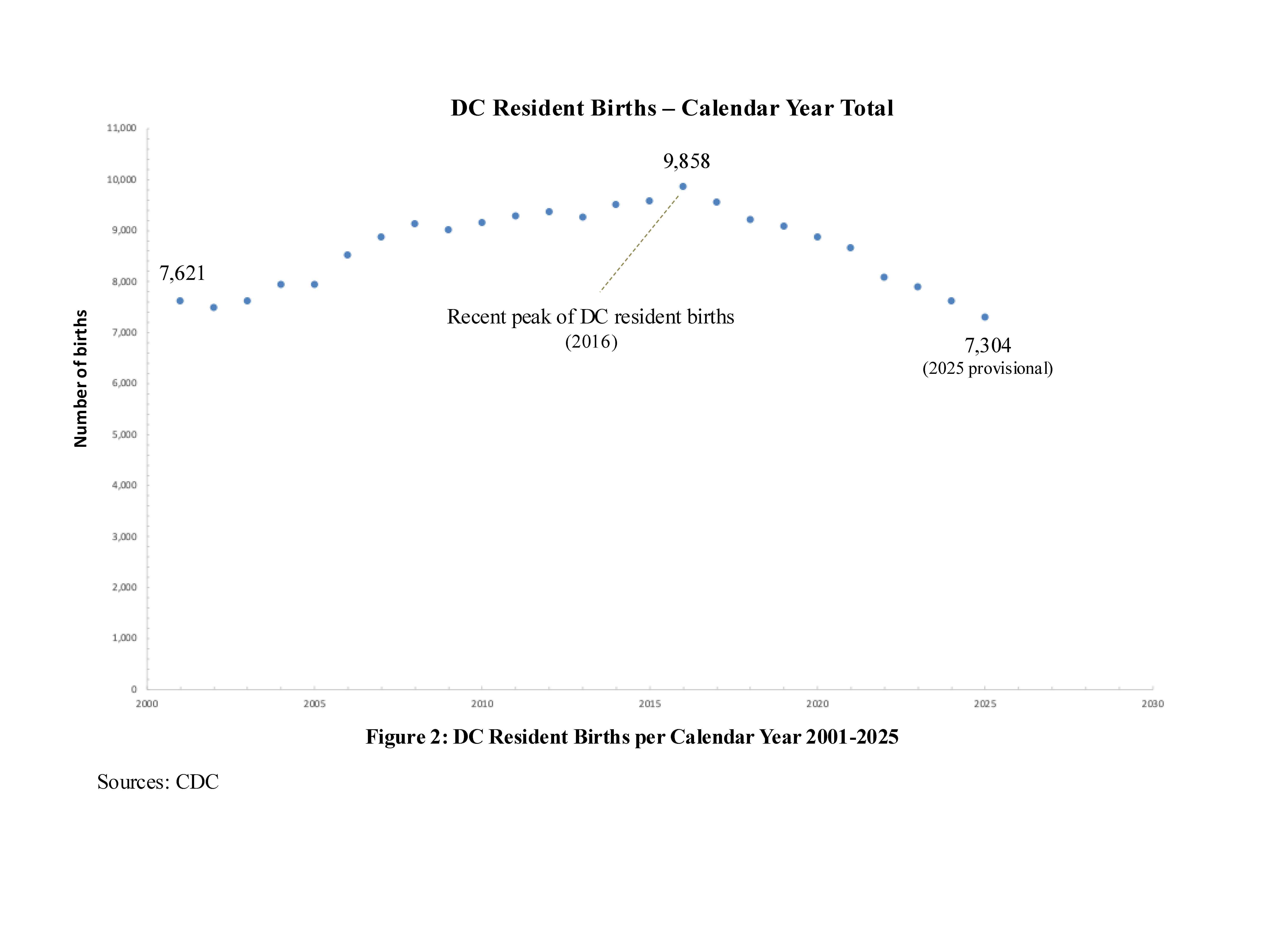
While this decline in births was not exactly unexpected (see here too), it inevitably means that the pool of available students for our publicly funded schools will be decreasing. Indeed, absent an influx of residents with children or a greatly increased birthrate of existing residents, this demographic shift (more than 2000 fewer births than a decade ago) will continue. This decrease in births may not have anything to do with DC’s schools by itself—but certainly it doesn’t lend itself to affirmation of DC’s school governance (or, possibly, affirmation of anything positive in DC).
–Combining this year’s decline in kindergarten and pre-K enrollment with DC’s birth rate decline means that we will continue to see declines in kindergarten enrollment in DC’s publicly funded schools for at least the near future, if not longer.
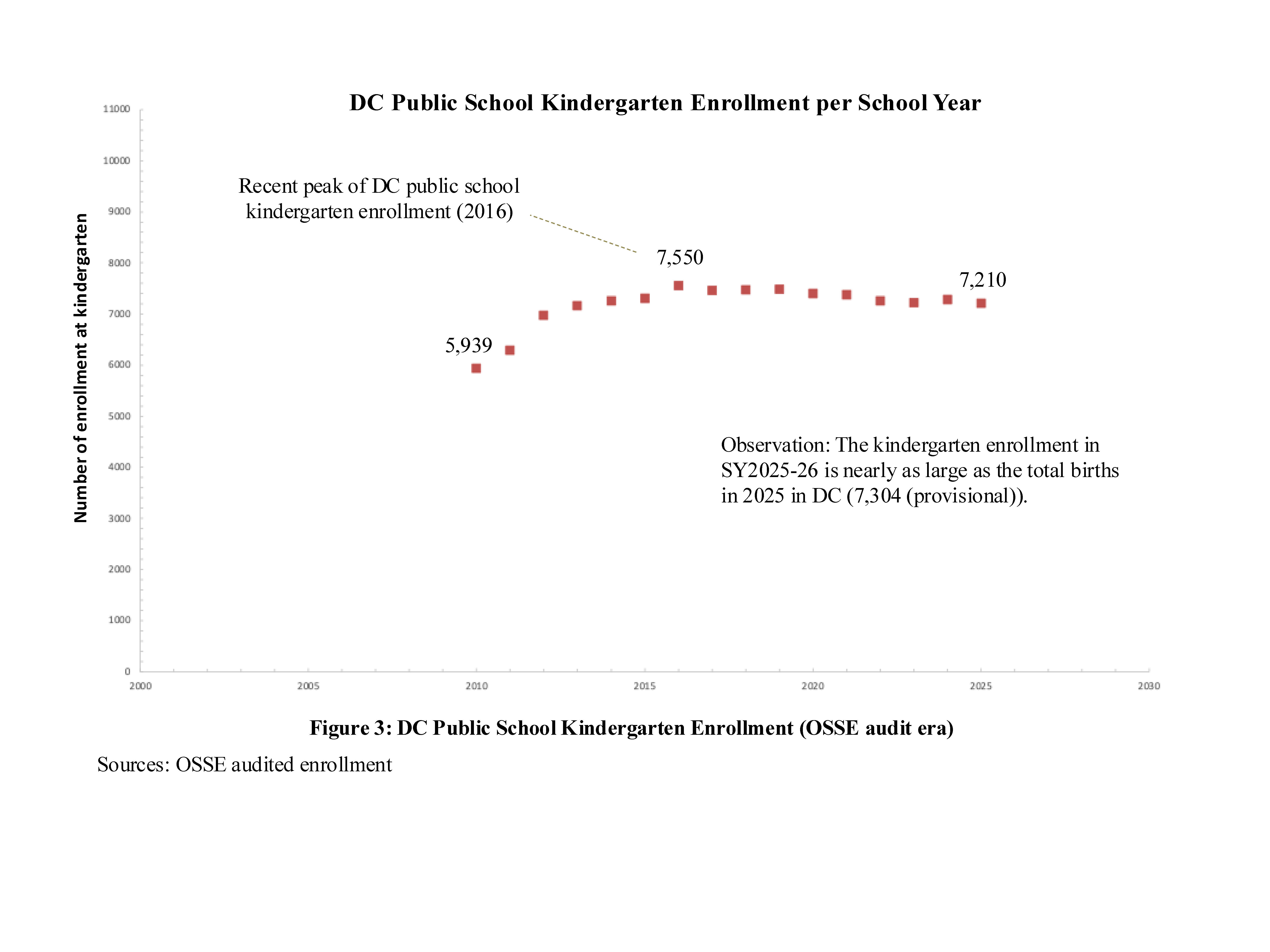
Once again, this is not exactly unknown. (See here, too.)
But: there’s more!
–Even as they have changed a little bit through the era of audited enrollments (AD 2010 on), DC’s cohort capture rates have remained steadily less than 82%.
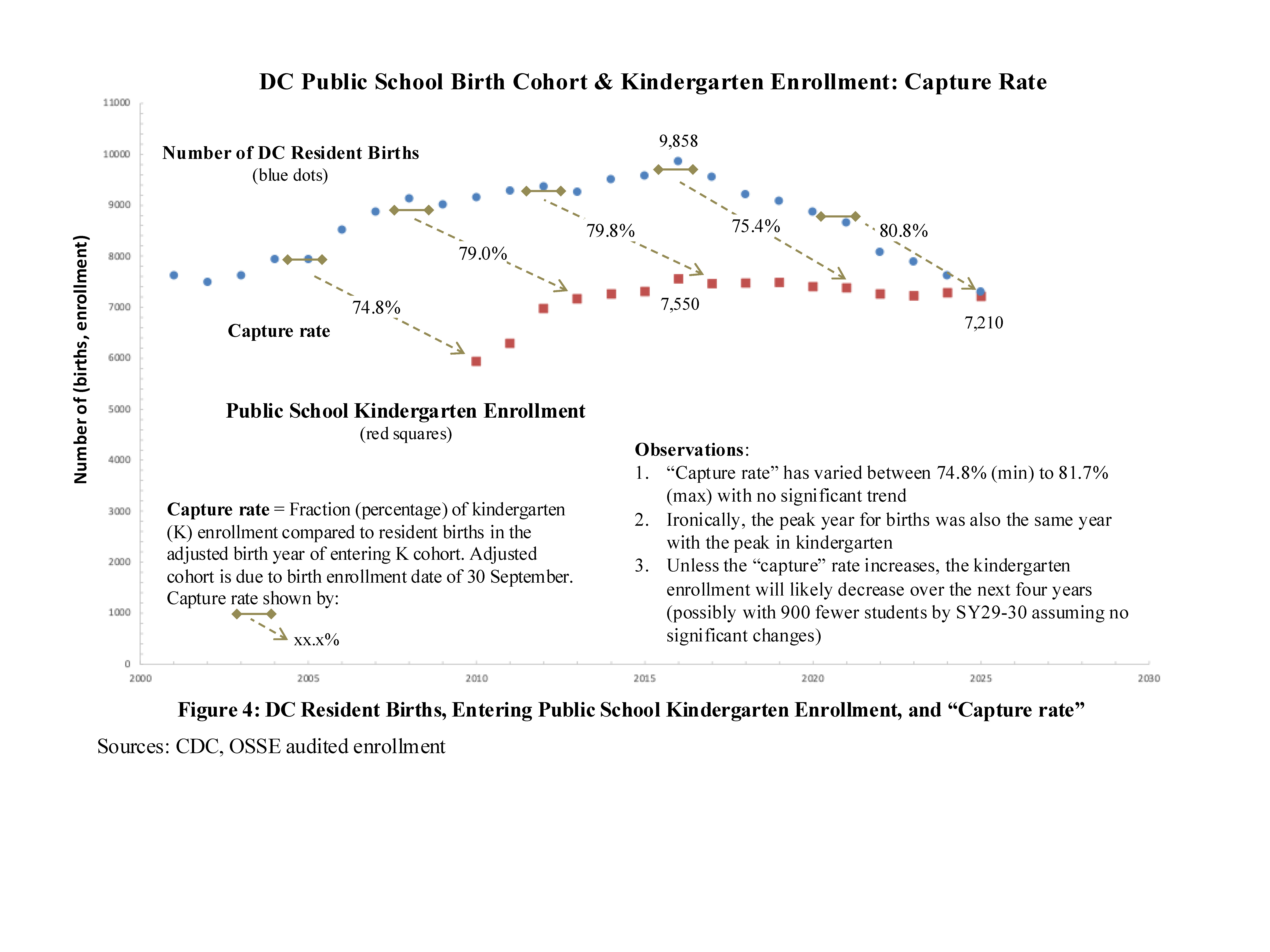
The fact that this capture rate remains at the same level after literally decades of heavy breathing about DC’s improving schools, governance, and [insert here whatever thing DC leaders love about ed reform and choice] suggests that not much is changing at all–at least in the minds of DC public education “consumers” (as ed reformers like to call us taxpayers with children).
None of that can easily (or at all) be construed to be a shining endorsement of DC education policies and governance.
–And while grade-level cohort retention rates have also not changed appreciably through the era of audited enrollments (AD 2010 on), they have always been negative for every grade-level transition through 8th grade. (Not gonna get into cohort retention rates for grades 9-12 because 9th grade is a transition year, with many students held back—but suffice it to say that some folks in DC have really worked hard to pretend that high school attrition doesn’t exist.)
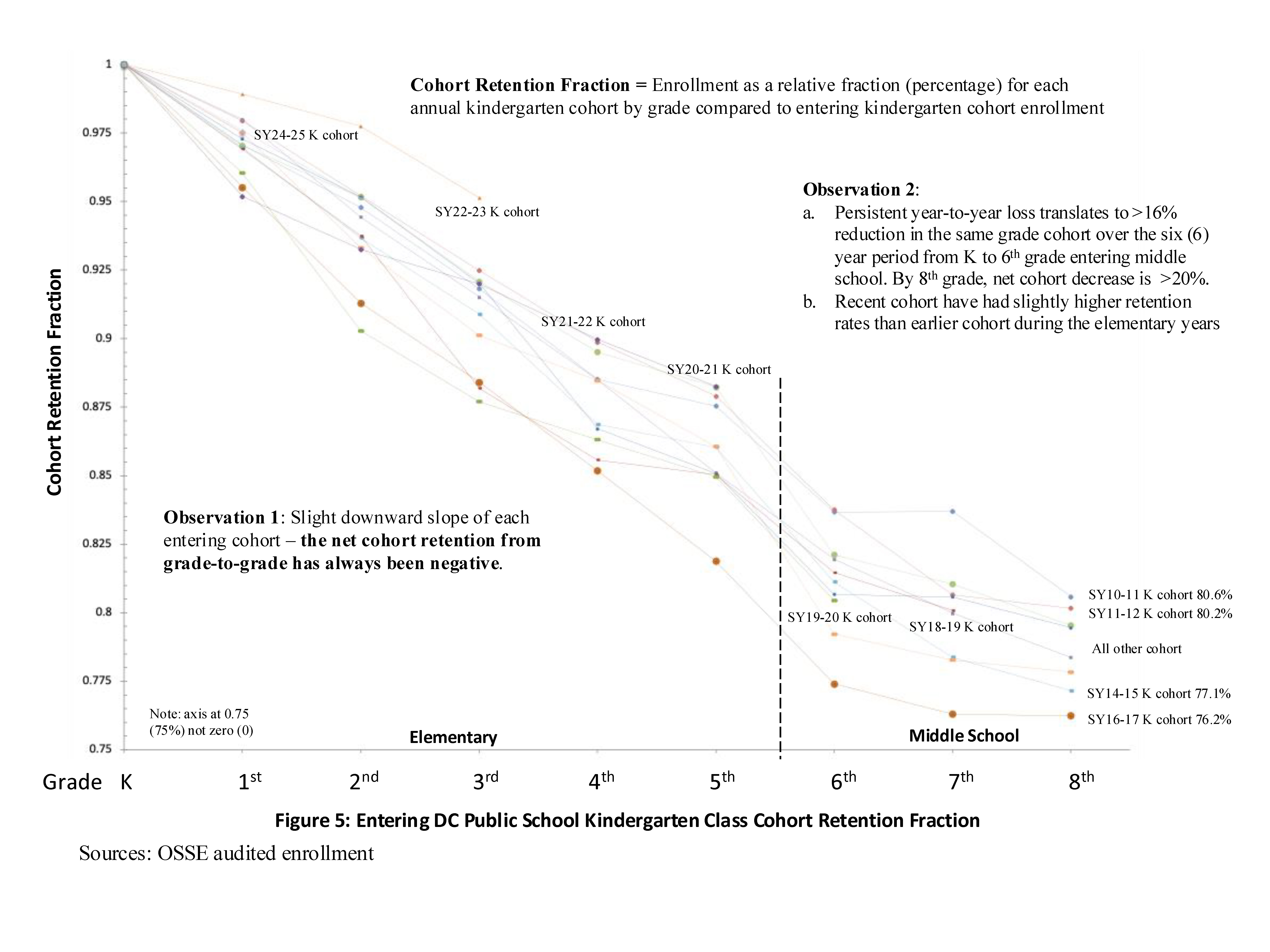
Bottom line: Unless DC’s capture rate and/or birth rate and/or influx of resident children and/or retention rate increases dramatically (and very quickly), kindergarten enrollment in DC’s publicly funded schools will likely decrease greatly over the next four years, with potentially 900 fewer kindergarten students by SY29-30.
This also means that by 2030, DC’s elementaries will likely have 3000 fewer students than they do now. This probable loss of students will not be reflected in middle and high school grades until after 2030—but absent changes otherwise, it will eventually percolate through to those grades, too.
Now, a near future where the entering kindergarten cohort is a full school’s worth of students less than now is not exactly what DC leaders want to tout–which may be why the latest audited enrollment data was released months late; unaudited enrollment data (from fall 2025) was never released at all; and no one said a word otherwise. Indeed, these demographic trends overshadow any real, or perceived, improvements in DC’s publicly funded schools.
In their own ways, the charter board and DCPS appear aware of the numbers. For instance, in its proposed budget for next school year, DCPS planned for an overall decrease of 1200 students, and the charter board is revising its expansion policy.
But there are three aspects of where we are now that I can only hope eat at consciences in the Wilson Building and beyond:
1. In the last 5 years, DC has literally spent hundreds of millions expanding DCPS schools of right west of Rock Creek Park when most never had a chance of filling all those seats with in boundary students.
The cost of this cynical waste of money and resources–done under the guise of “choice” and “equity” and “diversity”–will continue to almost entirely be borne by residents and schools in wards 5, 6, 7, and 8, whose kids are the ones ensuring those schools west of Rock Creek Park are filled.
And thus, there will be closures; those closures will happen most often in and around the city’s poorest wards, far removed from west of Rock Creek Park; and those closures (and accompanying budget cuts) will further the inequities that “choice” and expanding seats of choice were supposed to solve and never for a millisecond did for the majority of DC students (sorry, PAVE).
Indeed, we can see this bankruptcy play out in real time now with the just-released study for dual language programming in wards 7 and 8. That study concluded that for this purpose, the most “feasible” use of the closed DCPS school Winston, in Ward 7, was as a charter because of (checks notes) funding. Marla Dean, head of the Ward 7 education council, correctly noted that “funding feasibly was not a barrier for the MacArthur School or other WOTR schools. Funding only becomes a barrier when you get to EOTR communities. Not to mention charters have helped create funding instability in our schools.”
Some of us warned about this—and were ignored. The folks who cheered it on and those who made it happen deserve to have the seal of waste, fraud, and abuse attached to their resumes for the rest of their careers.
2. The charter board recently renewed for another 5 years charters for several LEAs that have financial pressures from decreasing enrollment (this year, Rocketship, Shining Stars, SEED, Thurgood Marshall, WLA—and, arguably, Children’s Guild and Bethune last year). While those schools are for the most part not outstandingly good or bad by the charter board’s own criteria, they have an important thing in common: They fulfilled the charter board’s criteria for renewal, which like its expansion policies have prioritized (and, absent massive change, are likely to continue prioritizing) market share and sector stability, not necessarily (or ever) teacher excellence and support, student and family experience, and truly public decision making about what schools are wanted; needed; and located.
Now, given DC’s increasing enrollment pressure, these charter schools are likely more vulnerable to closure in the next 5 years, with all that instability borne by the most vulnerable in DC: kids.
Again, there has been plenty of warning about this (see here and here, too). As with the DCPS expansion west of Rock Creek Park, the folks who cheered this willful blindness on in the name of “choice” and “equity” and “quality” deserve to have the seal of waste, fraud, and abuse attached to their resumes for the rest of their careers.
3. While it is nice that some folks in DC government have occasionally used their time to explore some of these demographic realities (see here too), no one in DC government AFAIK has ever spoken aloud about how bankrupt our governance around these realities has been—and what its ruinous consequences are.
That is because there are scores of people who have never lived in DC and/or sent their kids to public school here who have convinced DC elected and appointed officials to look the other way for decades about all of this. Their “convincing” has taken a variety of forms:
–Providing funding for astroturf organizations that, among other things, use DC parents for advocacy around choice and charters;
–Funding all sorts of studies that come to the conclusion that choice and charters are the only solutions; and
–Giving time, personnel, and money to have a hand in how decisions are made and actions taken in all our publicly funded schools.
There are many blog posts here about this shadow school governance in DC, so I am not going to link to them. But if you need a start, conduct a search with the term “wealth,” and you’ll get plenty of material. Alternatively, you can just watch a DC council hearing to see who is invited to be an “expert” witness on public education issues—then explore how they are funded and who they really represent.
The purpose of all that lobbying, funding, schmoozing, etc. is simple: To put public school money (and public school buildings) into private hands.
And since the advent of charters in DC, this effort has worked spectacularly well. As a board member for a charter school told me years ago, those folks sit up and take notice of any school system with more than $1 billion in taxpayer funds annually. Indeed, DC’s publicly funded schools (and their buildings!) have been ripe for the picking for businesses profiting from public money, including (but not limited to) banks (someone’s gotta handle the >$1 billion in DC charter debt); real estate firms; and developers. Not coincidentally, those businesses invest in DC’s elected and appointed officials profitably, too. (If you need a recent example, see how C4DC deconstructs the swift and otherwise indefensible release of Winston to the private sector by our deputy mayor for education–your tax dollars at work!)
Thus, expect that as DC’s public school enrollments shrink, so will public school budgets—but in inverse proportion to the rapacity of DC’s shadow public school governance.
Good luck in our brave new world.


Valerie, have you ever considered writing on the economic impact to DC of the PCSBs blank check on opening schools and charter expansion.
LikeLike
Yes–but in truth, I don’t know how to do that. There are two strands of DC taxpayer funding that DC charters have: facilities and per student expenditures. For the latter, as our council chair has pointed out, we would be paying the per student expenditures to DCPS if those students went to DCPS instead of charters. But that is not the whole story, because while that money *starts* as the same amount(ish) it then goes to often very different things–and one of those things that I think is arguably a huge waste is the overhead expenditures for every charter. DCPS also has this issue (ie a tiny school like Ross is v expensive per pupil compared to a much larger elementary bc you need to have a certain set of personnel regardless of the size of the student body). But unlike DCPS schools of right, charters are 100% OPTIONAL schools, so this admin overhead, if you will, is also 100% OPTIONAL. I presume that there are forensic accountants who can do this analysis–but it seems no one in DC government wishes to hire them for this purpose. Then, too, the charter facilities allotment is a black box inasmuch as there is no tracking of it and it can be used for anything. Is that a waste? Who knows? Again, I think forensic accounting is possible–but I personally don’t know how to do it, and certainly no one in DC government cares about this. We do know, however, that charters bank a significant amount of money every year overall–and that they are overpaid by at least $20 million in facilities funds annually. So is that waste? A forensic accountant probably could answer that. I also think that you could examine the facilities allotment over time in terms of what is spent for renovating a building. Then you could see if another charter renovates the same building in a short span of time (ie anything <20 years, which I think is a reasonable amount of time for renovated facility to start showing its age). You could then argue that this is a waste of money–except for the little rub that DC has invested in charters to support the concept of choice. So to the extent that a publicly funded renovation is needed to support X school in Y building even in a short span of time after a prior publicly funded renovation in the same building, one could argue that it is merely the price of choice. The problem, of course, is that we in DC have NO idea what that price actually is. Well, OK–this is a v long way to say ugh, I have considered this, but don't have enough skill to do it myself–but maybe I should hire someone!
LikeLike