
–On August 30, the charter board presented to the DC council its SY23-24 attendance and discipline report.
Despite listing a few details of high absenteeism and suspensions in some of DC’s charter schools, the report has no data on discipline at all of DC’s charter schools—much less the percentages of specific student groups disciplined.
And while p. 18 shows the 10 schools with the highest truancy rates, it doesn’t show that 24 schools have >20% of students missing >21 days of school (NB: numbers are not rounded up):
Achievement Prep (23%)
Center City (NoMa) (35%)
Chavez (25%)
DC Prep, Anacostia Middle (22%)
DC Scholars (24%)
Digital Pioneers (Capitol Hill) (46%)
Digital Pioneers (Johenning) (43%)
EL Haynes HS (22%)
Friendship Armstrong Elementary (25%)
Friendship Chamberlain Elementary (23%)
Friendship Chamberlain Middle (27%)
Friendship SE Elementary (41%)
Friendship SE Middle (33%)
Friendship Woodridge Elementary (27%)
Friendship Woodridge Middle (20%)
Girls Global (30%)
Harmony (23%)
I Dream (47%)
Ingenuity Prep (29%)
KIPP Pride (22%)
Shining Stars (33%)
Statesmen (23%)
Children’s Guild (49%)
Washington Leadership Academy (20%)
Of those 24 schools, some have relatively few students (I Dream, Harmony). But others are large (Friendship Chamberlain, Friendship SE, Friendship Woodridge, Digital Pioneers, Ingenuity Prep). That means the total number of kids missing a big percentage of school is also large–but completely obscured.
And that is not mentioning the plethora of schools with *almost* 20% of students missing more than 21 days of school, accounting for thousands more students missing large chunks of the school year.
AFAIK, no one has commented on this charter board report or its findings–which seems weirdly fitting. After all, a 2017 GAO study found that Black students and students with disabilities were much more likely to be suspended from DC’s charter schools. Yet that report—and the discipline data it published for specific schools AND specific groups in those schools—have as far as I know never been publicly commented on by any DC official OR replicated in any of DC’s annual discipline reports. The only data we the little people have gotten has been on overall suspensions and expulsions–and never by school since the 2018-19 report issued by the office of the state superintendent of education (OSSE).
(But feel free to explore OSSE’s web page for annual discipline reports and enjoy the SY15-16 report, which features graphs starting on p. 42 with no x-axis, indicating that OSSE that year had this data by school (and likely by specific groups in each school) and was actively choosing to NOT disclose it. Yay, school choice!)
–The SY23-24 results for DC’s standardized testing (CAPE) were released in August. Parent and education researcher Betsy Wolf outlined the results here, which are very similar to last year’s.
So naturally, we heard of great success!
Specifically, in the wake of an independent report on the effects of high-impact tutoring (HIT) in DC’s publicly funded schools, OSSE included this slide on p. 18 of its report on CAPE:
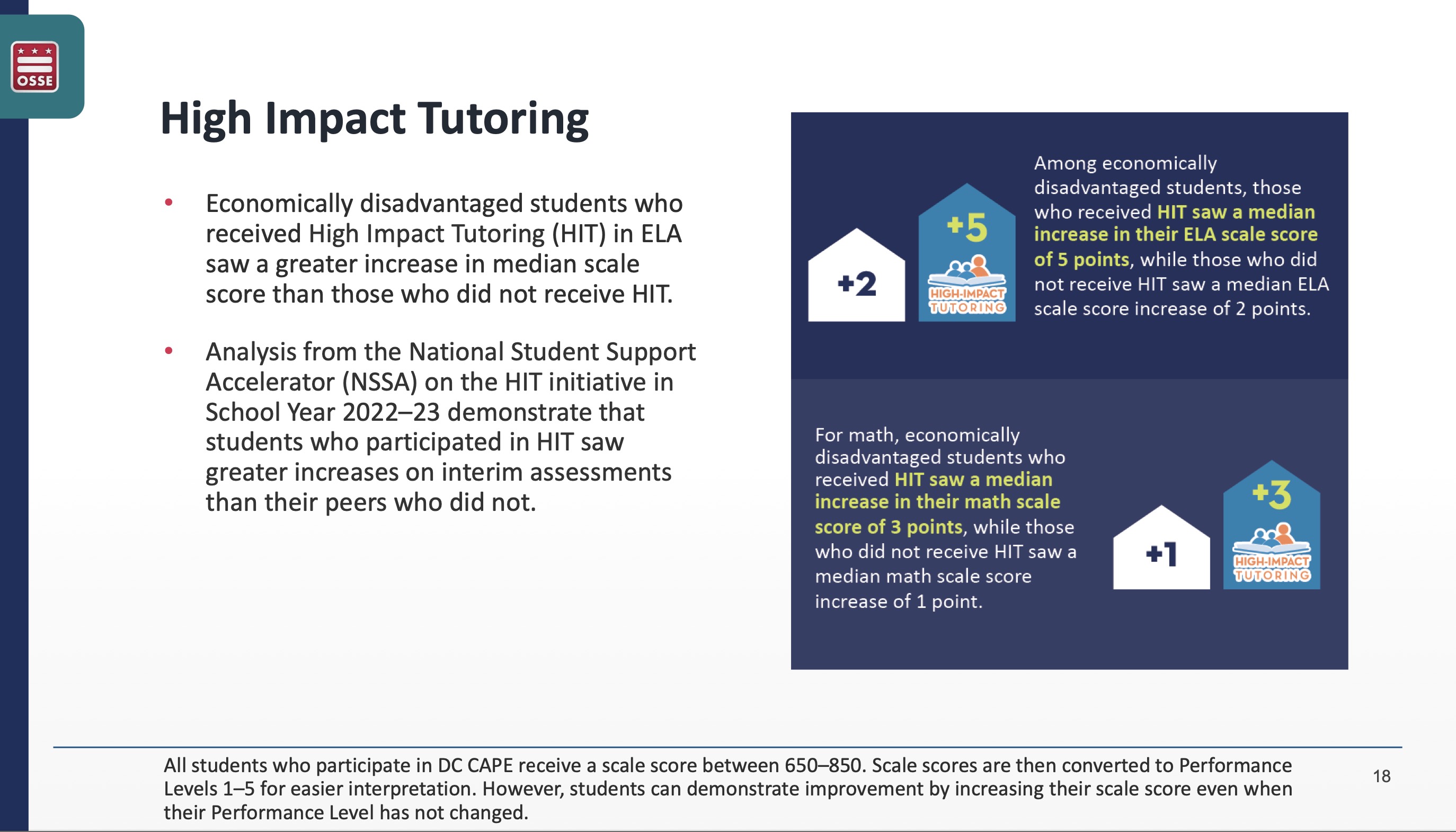
The only trouble is that the original HIT report noted only a slight difference for the effect of tutoring–and no evidence that tutored students had greater achievement than those without tutoring, which is what this slide implies. Not to mention that nowhere in either report was it outlined who participated in HIT; at what schools HIT was used; and under what circumstances, so effective replication is at best obscured.
(For analysis by Wolf of this deceptive (ab)use of HIT, see here and here and here.)
–A new research paper outlines how churn in the last 20 years of DC’s publicly funded schools (opening and closure) tracks with gentrification.
(In other news, water is wet and the sun rises in the east.)
While most DCPS closures have not happened in the last decade (except for Washington Met in 2020, RIP), some recent DCPS expansions are MacArthur HS and an expanded Banneker HS. Then, too, Excel (whose facility was the former Birney) was brought back into DCPS from being a charter, as was Dorothy Height (whose facility was the former Burdick) and Military Road (whose facility was last occupied by LAMB, which bought it from DC and then resold it to DC in what one can only call a fiscal victory for real estate agents and the private organization running LAMB). The Euclid St. building of the former Banneker will re-open as a neighborhood DCPS middle school, like the once-closed and now open again MacFarland did.
But for all the folks who bleat that both sides do it, this growth in DCPS doesn’t at all match the growth of seats and schools in DC’s charter sector. And the growth overall has accelerated in the last decade such that the number of unfilled seats in existing DC publicly funded schools has increased from 20,000 to >30,000.
It’s a tremendous (and avoidable!) waste of resources that the folks in charge (hey there, council chair Mendelson!) think doesn’t actually cost *anything* because we pay for the students in charters anyway!
Which is correct, to a point—except that such happy bothsiderism doesn’t account for the vast duplicative school administrations we have right now with charter proliferation; inflated administration salaries at those charters (hey there, Eagle Academy, Friendship, and KIPP DC!); and the fact that depopulated DCPS buildings represent a sunk cost and are relatively inexpensive to maintain to ensure education rights are secured in every quarter.
(So don’t hold your breath to hear any DC reps. say that.)
–A former DCPS employee was caught steering contracts for gain—while a DCPS teacher points out the obvious.
(Would that someone would examine DC’s other LEAs, for which there is no one place where to find all contracts, all their costs, and what they were used for. Because that’s private business or something.)
–Speaking of untracked public education expenses:
Apparently there is no good source that tracks by school district annual expenditures of public money on private education consultants. So while the firm that has benefitted from school closures and performance issues here in DC is now being tasked with closing down Eagle’s charter school in Nevada (naturally), it represents a state-spanning fiscal win for churn and private gain that is completely UNtracked by any government agency anywhere. (Hey there, GAO!)
In the meantime, some of the nonprofits running DC’s charter schools are accumulating public money–and then hiring investment managers to profit from that money.
(Hey there, Washington Latin! Hope the $504,128 you recently spent for financial services is worth it—at least, according to your 2022 990 where that expense is outlined on p. 8, you got a lot more investment income than the prior year (see p. 1). And hope you’re getting a great return on that $30 million in public money you invested in 2022, DC Prep—although I have to say that according to your 2022 990, you have not recently realized the $8.27 million in investment income that you had the prior year. Easy come, easy go? Only you can tell!)
Now some people might say that this is a direct transfer of DC taxpayer money to private companies. Which begs the question: why isn’t DC realizing these savings? And why does DC keep giving lavish amounts of public money to nonprofits that clearly do not need it and are not using it directly for students?
(Add those queries about our charters to another list of unanswered questions therein.)
–And once again (this month, this school year, this calendar year, this decade), buses for DC students with disabilities are not working. While there may be official outrage against . . . erm, a teacher for testifying (??), our reps don’t appear to be saying much about this latest escapade involving our students—or frankly any of the other stuff herein.
Don’t ask, don’t tell indeed.
 educationdc
One thought on “A Stunning Lack Of Truth & Action (And Other Recent Events in DC Education)”