
In January, the DC council held two hearings on teacher and principal retention in our publicly funded schools. The first hearing (on January 21, video here, hearing record here) featured two panels (one on teacher retention, the other on principal retention) as well as a host of public witnesses. The second hearing (on January 22, video here, hearing record here) featured two government witnesses: the DCPS chancellor and the assistant superintendent of teaching and learning at the office of the state superintendent of education (OSSE).
The theme in both hearings was depressingly familiar: teacher turnover in DC is still high, though not as high as in the recent past. For instance, per the mayor’s own statement, teacher retention this year at the same school is 78% across the entirety of DC’s publicly funded schools, and 81% for principals, both up a few percentage points from recent years. Per this OSSE chart, for SY25-26 teacher retention at the same school in charters averaged 74%, while it averaged 82% for DCPS.
For the most part, council chair Phil Mendelson did not let sector differences intrude on his oversight. In fact, the teacher and principal panels at the January 21 hearing (no explanation on how participants were selected) included the head of DC Prep (SY25-26 teacher attrition 33%) and the KIPP DC chief of schools (SY25-26 teacher attrition 23%).
The entire picture of school employment in DC is—and has been—a big, ugly deal. Certainly, the January 21 public witnesses (who started after more than 2 hours had elapsed) made that clear for Mendelson and the few other council members (Frumin and Nadeau) who showed up. Specifically, most witnesses pointed out long hours, adverse consequences of poor retention on morale and students, the abandonment of foreign educators, poor teacher wellbeing supports, inadequate staffing, lack of stability, and under-resourcing for teachers. At the 2:34:19 mark the head of the WTU, Laura Fuchs, pointed out the irony of how teacher turnover had been once construed as good because it got rid of so-called bad teachers, while now it is construed as bad. As Fuchs noted, most teachers in DCPS do not stay beyond 5 years, while many schools have consistently high annual turnover rates.
While the government witness hearing the next day was notable for Mendelson grilling the DCPS chancellor about schools with the lowest teacher retention rates, more notable to me was what was not really mentioned at either hearing—mainly, charter schools with low teacher retention and teacher pay.
Well, that last bit is not entirely true:
At the January 21 hearing, for instance, Mendelson brought up pay equity between sectors (starting at the 5:10:56 mark), by saying that WTU pay raises (as a result of DCPS contracts) were outside the UPSFF (the uniform per student funding formula) and though the mayor provided something so charter teachers could also get a pay raise, it wasn’t the same amount as what DCPS teachers received.
Now that was a fascinating observation—if for no other reason than it appeared to be one of the few times anything was said about teacher pay in the many hours of these hearings. OSSE itself appears to have no posted data on teacher pay—which is kind of, well, incredible to me.
Back in the hoary days of 2023, OSSE pledged to post something about charter teacher pay—specifically, with respect to how charters were using the money they were granted as a result of the ratification of a long overdue DCPS teachers’ contract (with DCPS teachers’ subsequent increase in pay). Notwithstanding that absolutely no charter did anything to get DCPS to cough up this money (thank you, DCPS teachers!), city leaders passed legislation that ensured about $73 million would be distributed by OSSE to charters starting in SY23-24. The idea was that charter teachers would receive bonuses and salary increases with this money.
But how, exactly, that all went down is an open question.
DC code itself provided that charter teachers’ compensation would be raised by 7.6% retroactively, then subsequently by 12.5%. But on p. 47 of its responses to council oversight questions in 2024, OSSE said this (boldface mine):
“In SY23-24, OSSE will provide public charter LEAs over $73 million to increase compensation for teachers and other school-based staff; as of February 2024, more than $64 million has been paid out. To receive these funds, charter LEAs had to meet three minimum criteria: 1) provide 7.6% retroactive bonuses to returning SY22-23 teachers, 2) raise SY23-24 pay scales by 12.5% as compared to SY19-20, and 3) publicly post their SY23-24 teacher pay scales or their minimum, maximum, and average teacher salaries if they do not have a pay scale. By May 2024, all charter LEAs must develop, implement, and publicly post their SY24-25 pay scales. Once these requirements were met, charter LEAs were able to direct any excess funds to direct compensation for other school-based staff, particularly those in student-facing roles such as paraprofessionals and social workers. All alternative uses of funds must be approved by OSSE and will be publicly posted on OSSE’s website. These funds were critical to increasing teacher compensation, incentivizing teacher retention, and increasing transparency for charter teacher salaries in the District.”
So: was that 7.6% a bonus–or a salary increase? I tried, and failed, to find anything about OSSE posting “alternative uses” of those extra funds. I found this OSSE website, for instance—but it didn’t have anything about alternative uses. (As of the posting of this blog, an answer to my query on this subject to Elizabeth Ross, OSSE’s assistant superintendent of teaching and learning, remains in process.)
To be sure, even if OSSE kept records of charters doing anything with that particular tranche of money, this is now all water under the bridge, inasmuch as future charter teacher pay raises as a result of any DCPS teachers’ contract (here’s the latest, signed in 2025) are incorporated (kind of) with the UPSFF.
That, however, raises a whole host of other questions, such as
–Do all charter schools publish teacher salaries or at least scales?
–Does the council know (or care) what charter teachers are actually paid?
–Does OSSE know (or care)?
OSSE guidance provides that charters must attest to the use of the extra money for their teachers and outlines verification procedures. However, there is nothing in that oversight to provide for any independent verification via auditors or even by the council. The guidance notes merely that if something appears amiss when OSSE compares each charter’s educator expenditures from one year to the next, OSSE “will engage with the LEA to gain additional clarity and follow-up with next steps.” I was also unable to find anything mentioned on this topic by either OSSE or the council in documents for OSSE’s March performance oversight hearing. (Charters recently received $647.78 per student for this purpose, amounting to more than $30 million.)
Such lack of scrutiny appears to be (at least in part) by design, as charters are allowed to use UPSFF funds with great flexibility. For the council’s part, it is unclear what, if anything, they know about this. At an oversight hearing on March 3, 2023, for instance, council member Christina Henderson mused about large amounts of cash on hand at DC charters and wondered whether they should pay their teachers better. Almost 3 years later, at the February 25, 2026 oversight hearing, Phil Mendelson remarked (at about the 9 hour 18 minute mark) on the higher turnover of teachers in DC charters and suggested that charter schools with large amounts of cash on hand should (wait for it!) pay their teachers better—and that maybe there was a correlation between retention and teacher pay.
Quite possibly, Mendelson’s February 2026 musing about charters’ cash on hand was inspired by his exploration (at the 3 hour mark and, more expansively, at the 5:07:15 mark) at the January 21 teacher retention hearing of public witness suggestions for a fund to support substitutes and a teacher retention fund managed by OSSE.
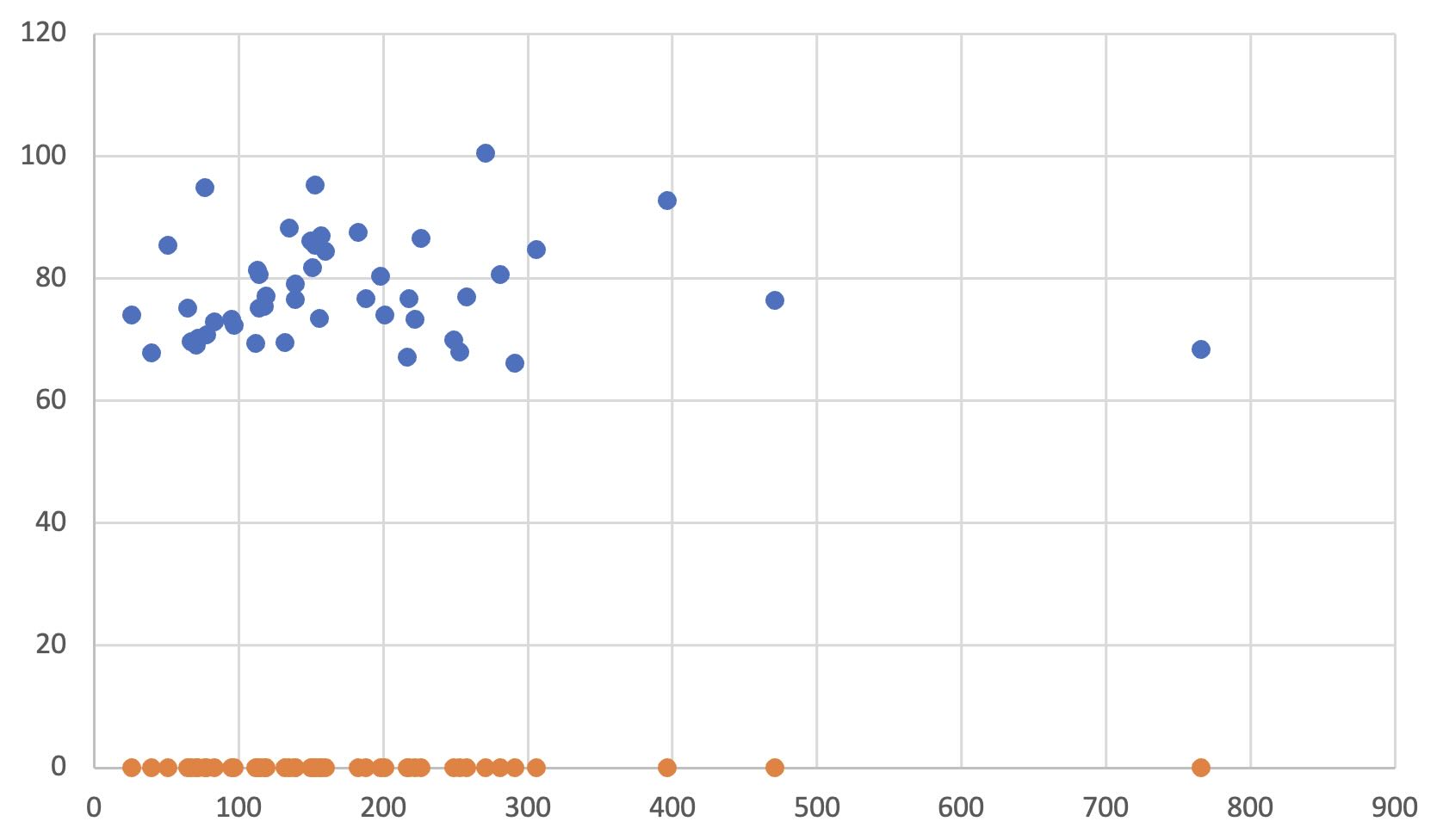
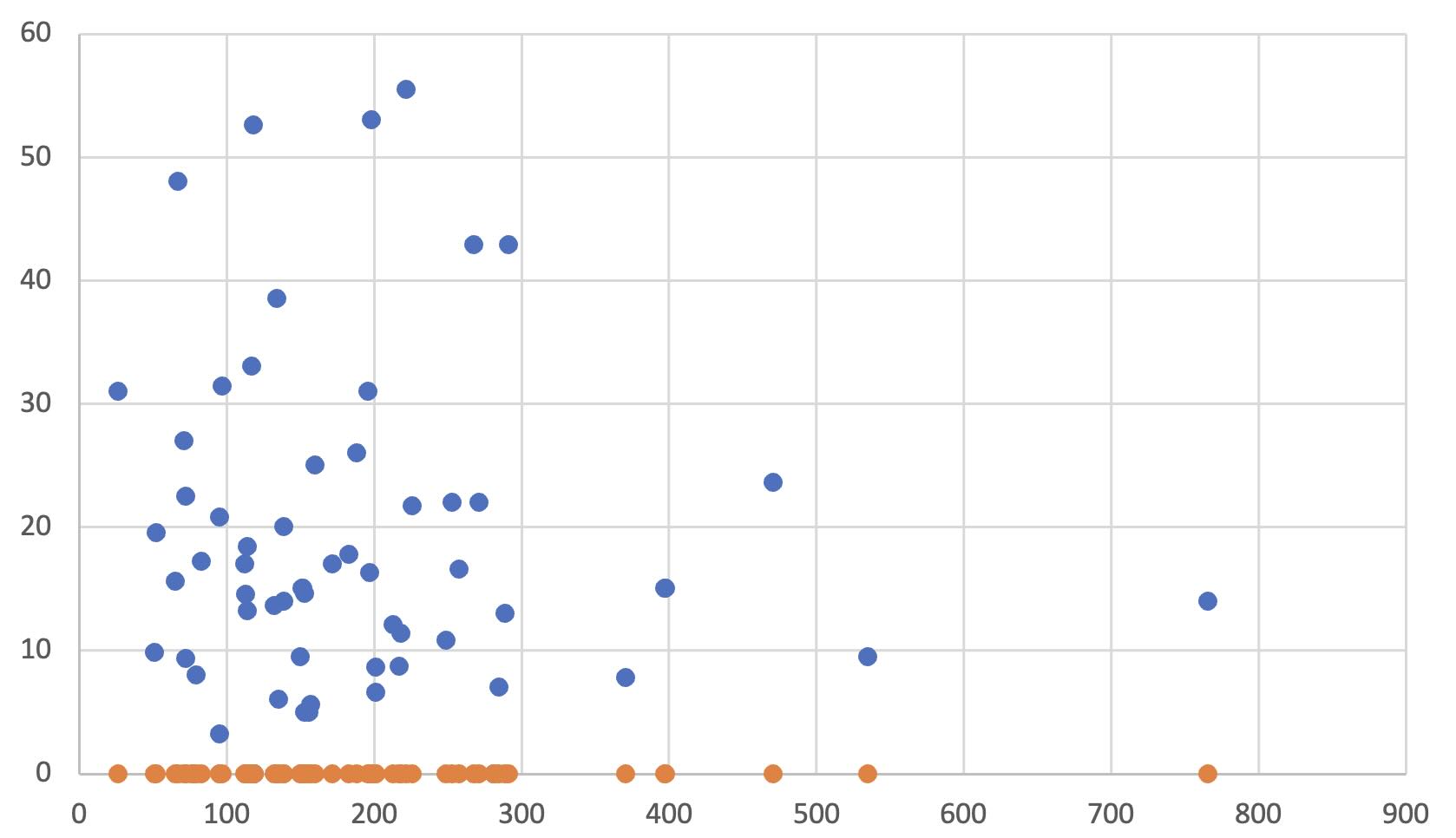
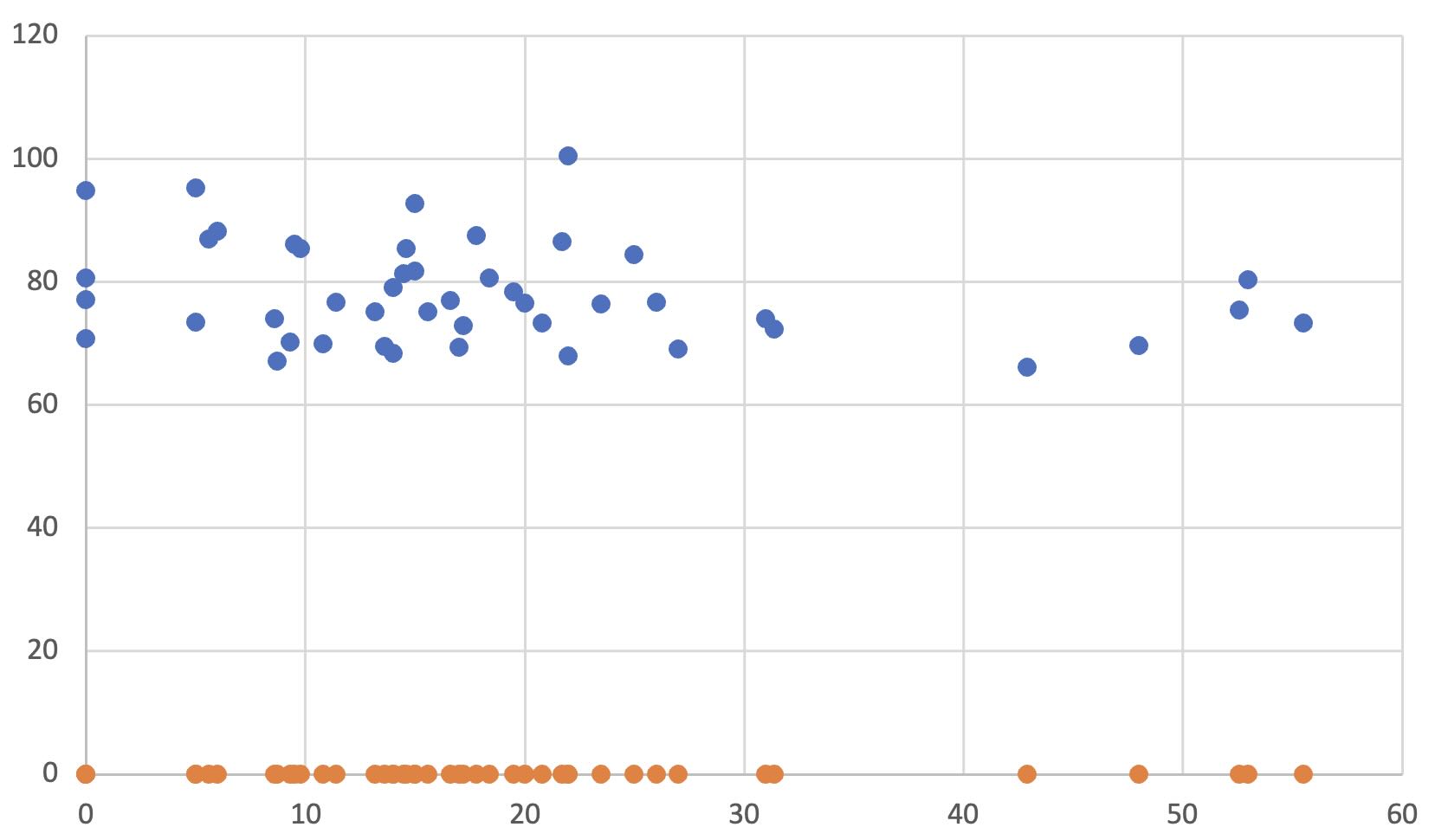
Regardless, I decided to take Mendelson up on his February musing—so have put below 3 scatter graphs comparing charter cash on hand, teacher pay, and attrition, using SY23-24 data.
Now, admittedly, this is rather a silly exercise.
For one, there appears to be no relation whatsoever between cash on hand, teacher pay, and attrition in charters—at least with this data of this one point in time. (Maybe over time—and/or in individual charters? Maybe??)
For another, this data is not recent. But SY23-24 data is the latest I have access to for charter cash on hand. This is because the latest data publicly available for this is from the charter board’s financial analysis reports (FAR), the latest of which (FY24) is years behind the present, despite having been published in January 2026.
Similarly, each charter’s annual report is supposed to have something about teacher pay and attrition. But the latest annual reports for individual charter schools posted by the charter board are from SY23-24. Now, it is possible to go to each individual charter school website to see if there is a more recent annual report posted. That said, it made sense to me to have the data points on attrition, pay, and cash on hand be close in time.
Regardless, the data I found in those posted annual reports was often incomplete. For instance, some charters did not post anything about teacher pay and/or attrition, while others just posted salary schedules, not averages. While the latter seems in accord with that law around charter teacher pay increases, without numbers of teachers at each level, it obscures what teachers at each school are getting paid on average. (NB: For both pay and attrition data at schools with multiple campuses and separate reports for each campus in their annual reports, I calculated and reported averages across all campuses.)
In addition, per that OSSE guidance above (“by May 2024, all charter LEAs must develop, implement, and publicly post their SY24-25 pay scales”), I did a google search for dc charter pay scale SY25-26 and got results for some DC charters. But while some of those charters had their SY25-26 salary scales accessible directly from their own websites, one of the salary scales that turned up in my google search I could not access directly from the school’s website (not to mention that I found a website with only an old salary scale).
(So: Is posting salary scales still mandated or was that just for SY24-25—and who’s checking, anyway?)
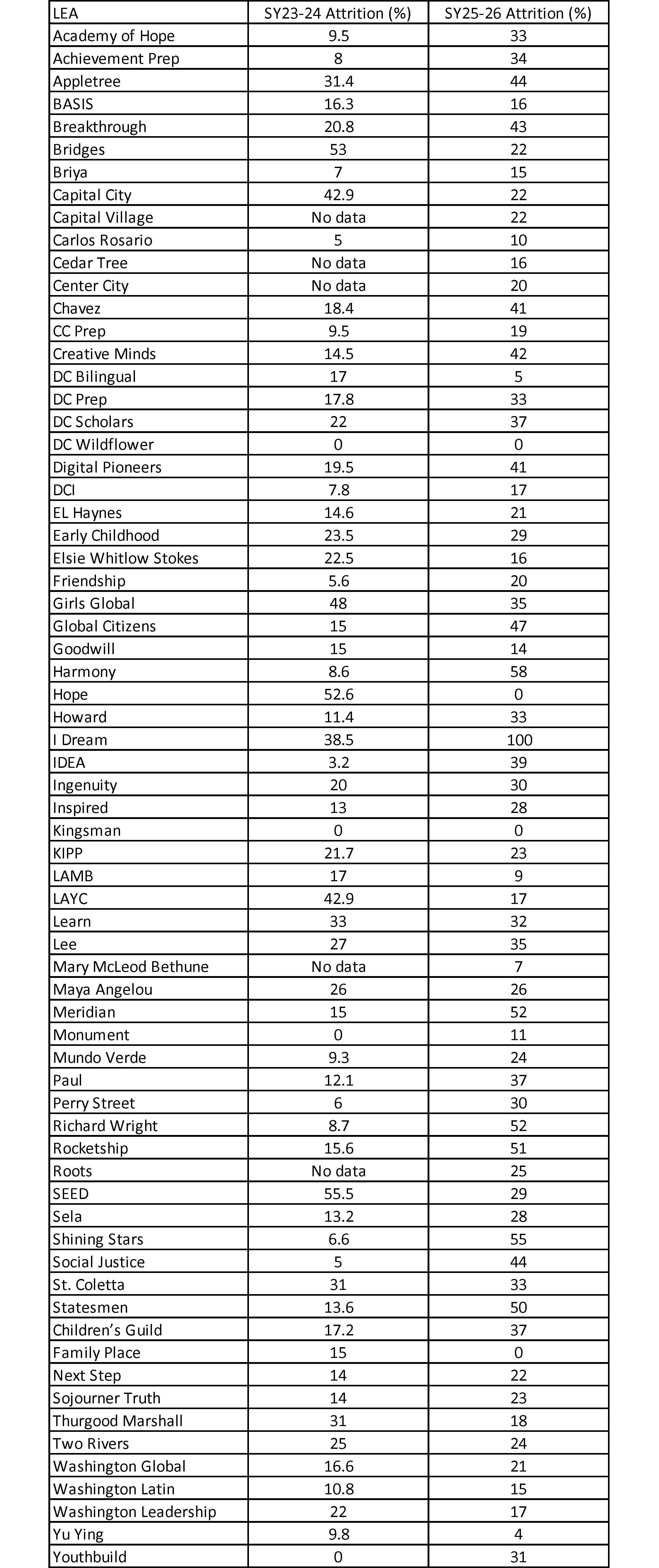
The only up-to-date annual charter teacher attrition data that I could find was in OSSE’s annual retention reports. There, I was able to download this chart with teacher retention data in both sectors for SY25-26. I then created the table below, using those two sets of teacher attrition percentages at each charter school: the most recent figures reported in each LEA’s annual report (SY23-24) and the other mandated by (and reported to) OSSE (SY25-26).
This table on attrition makes apparent really only one thing: the majority of charter schools have better retention percentages in the older data (ie the stuff from their annual reports). This would seem to contradict the most recent reporting of teacher retention in DC’s publicly funded schools, which is increasing overall (and in the charter sector as well). So: Is this because annual reports are not subject to the same scrutiny that reporting to OSSE is? Because it is measured differently for the annual reports? Who knows?
Perhaps by now, you too can hear Mary Levy’s warning of “garbage in, garbage out”:
Namely, OSSE should know EXACTLY how this goes down every year. They have the most recent attrition data; they know the exact (and recent!) amounts charters use to pay their teachers and can calculate timely (and accurate!) pay averages; and OSSE could demand more up-to-date stats for charter cash on hand, if they don’t already have that.
But this isn’t happening. OSSE doesn’t do it. And as far as I can see, the council doesn’t even bother asking anyone for it.
Instead, the council has literally spent YEARS idly wondering whether charters might use their cash on hand to pay their teachers better, as retention rates and teacher pay in charters lag that in DCPS. At the same time, the council has approved tens of millions extra to charters for their teachers with absolutely NO idea of how, if at all, that cash is making a difference in retention (or frankly much else).
Clearly, robust data collection and publicly available analysis around teacher retention and pay in all our publicly funded schools remains beyond our grasp–and apparently beyond the caring of anyone in DC government.
IMMEDIATELY BELOW: Scatter graphs comparing charter cash on hand, teacher pay, and attrition, using SY23-24 data from the charter board’s FY24 financial analysis report and SY23-24 LEA annual reports posted on the charter board website.
BELOW: Annual teacher attrition (%); data from LEA annual reports (SY23-24) and OSSE (SY25-26).
 educationdc