
Until the DC council held a hearing on Eagle Academy’s demise, on December 5, 2024, what was publicly available of the DC charter board’s fiscal monitoring list was simply a quarterly list of school names. The schools were identified for inclusion on the fiscal monitoring lists by the charter board’s finance committee—without any specific explanation as to why each was included or whether they had been there before (and if so, when). Once on a list, a school could be removed at any moment, for publicly undisclosed reasons—with no public notification. There was literally no tallying over time—just lists at discreet points in time.
In accord with such a publicly opaque approach, those lists have been available to the public in only the most indirect manner: Posted in brief memos in the board materials for the meetings at which they were on the consent calendar. Neither the memos nor the lists can be accessed by searching the charter board website. Instead, one can find them only by searching board meeting materials for every board meeting.
Moreover, because these memos and the lists they contain are part of consent calendar materials that are voted on all at once, it is unlikely to find any discussion of them specifically by board members.
Naturally, all of this has had the direct effect of burying fiscal concerns.
Eagle Academy provides a good example: Until its special board meeting in July 2024, the charter board’s only mention of fiscal concern around Eagle was to list Eagle alongside other charters in these quarterly memos. See, for example, here for the memo voted on during the charter board’s February 2024 meeting; here for May 2024; and here for August 2024 (which confusingly had another board memo dated 8/19/24 but that covered a meeting of the finance committee from 6/15/23—because of course).
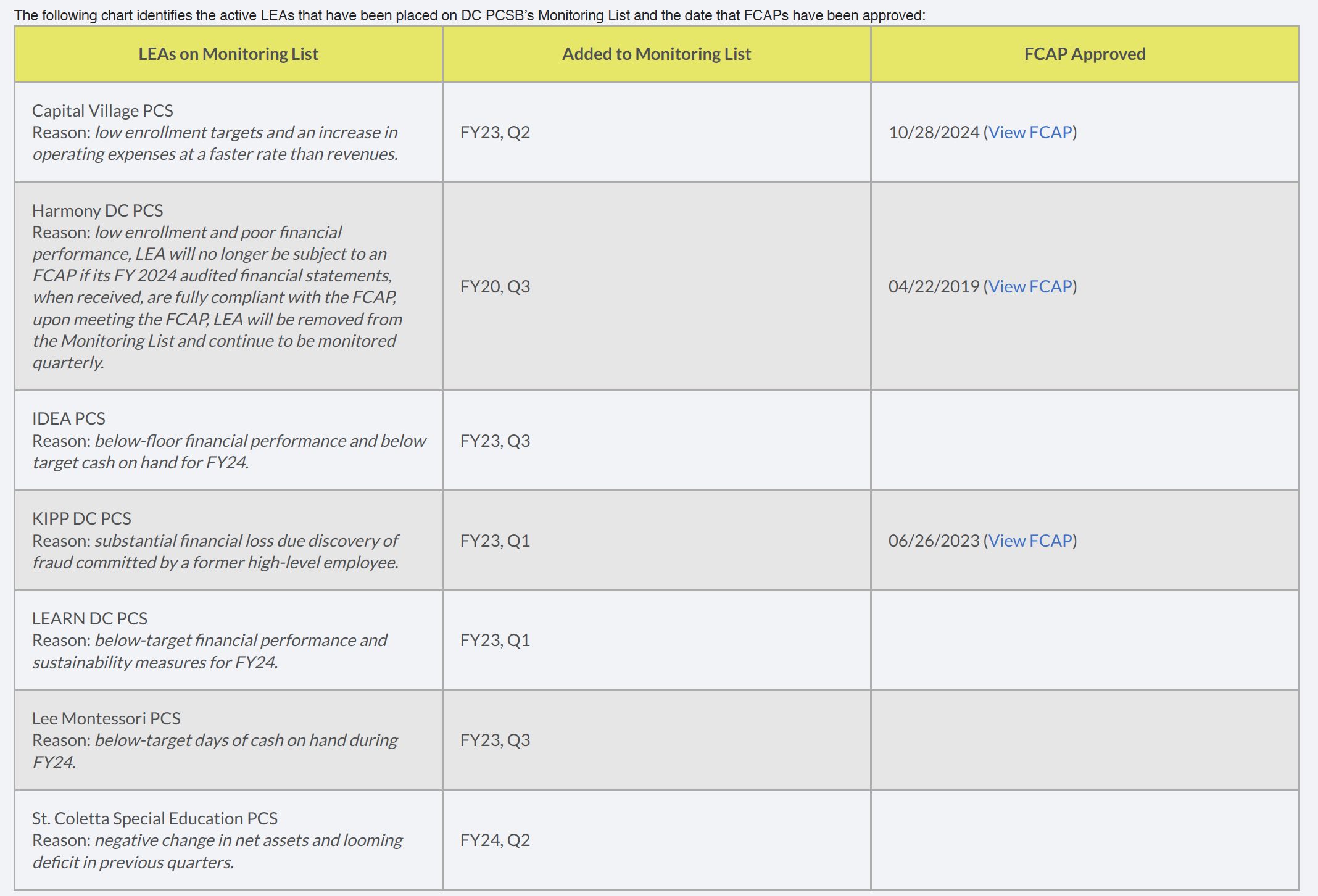
That said, in a marked improvement for public accessibility, the day after the Eagle hearing (December 6, 2024) the charter board posted on its website the following chart of schools then on its fiscal monitoring list:
A few weeks later, at its meeting on January 27, 2025, the DC charter board approved (but did not discuss) items on its latest consent calendar. Among those items was a board memo outlining the latest quarterly meeting of the charter board’s finance committee. That board memo (see it here or here) included a chart dated 12/20/24 with schools on the charter board’s fiscal monitoring list:
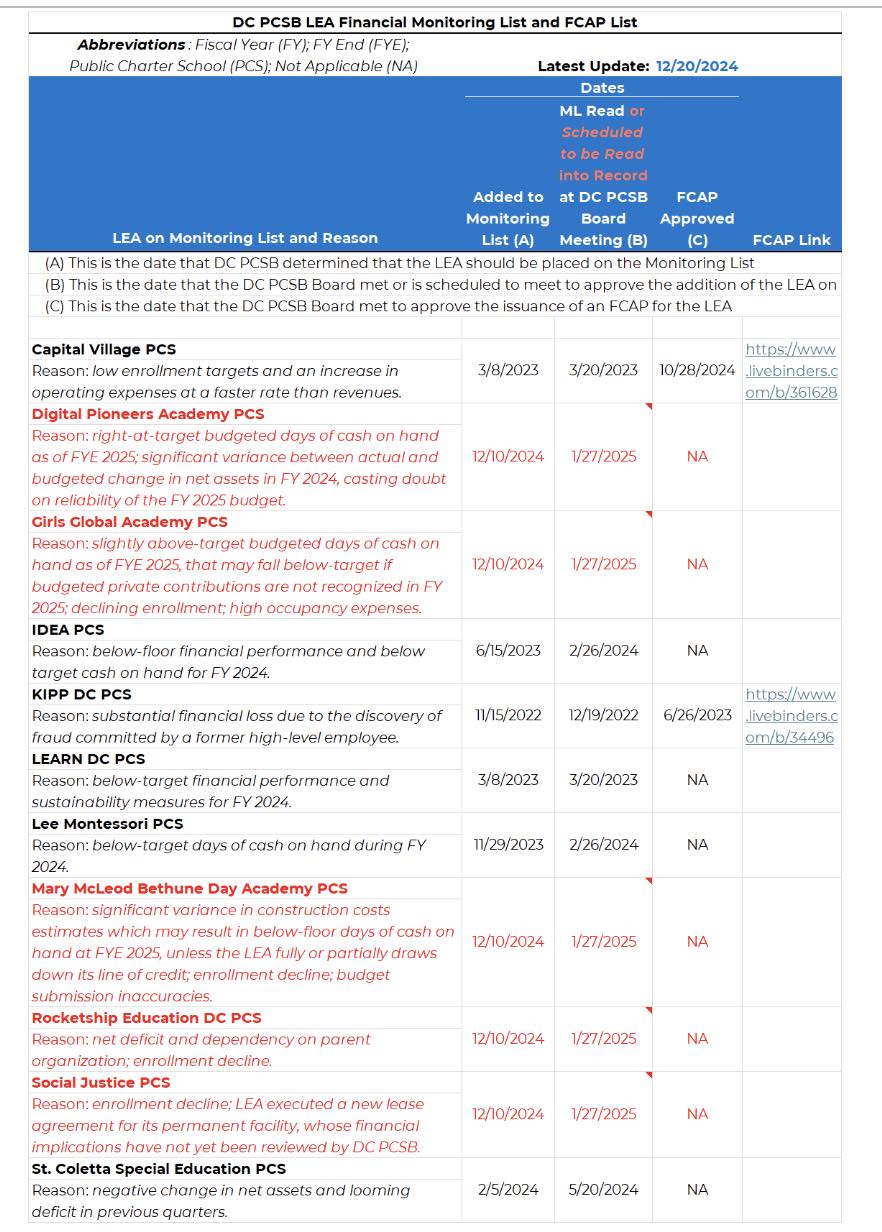
This chart shows that on December 10, 2024, five schools were added to the fiscal monitoring list from December 6 (pictured above this chart): Digital Pioneers; Girls Global; Mary McLeod Bethune; Social Justice; and Rocketship.
Now, this all seems like a step in the right direction for better transparency!
Except it’s not.
That is because at some point the chart directly above was removed from the board materials for the 1/27/25 board meeting. It was apparently swapped out for another with the same 12/20/24 date, but without Rocketship on it:
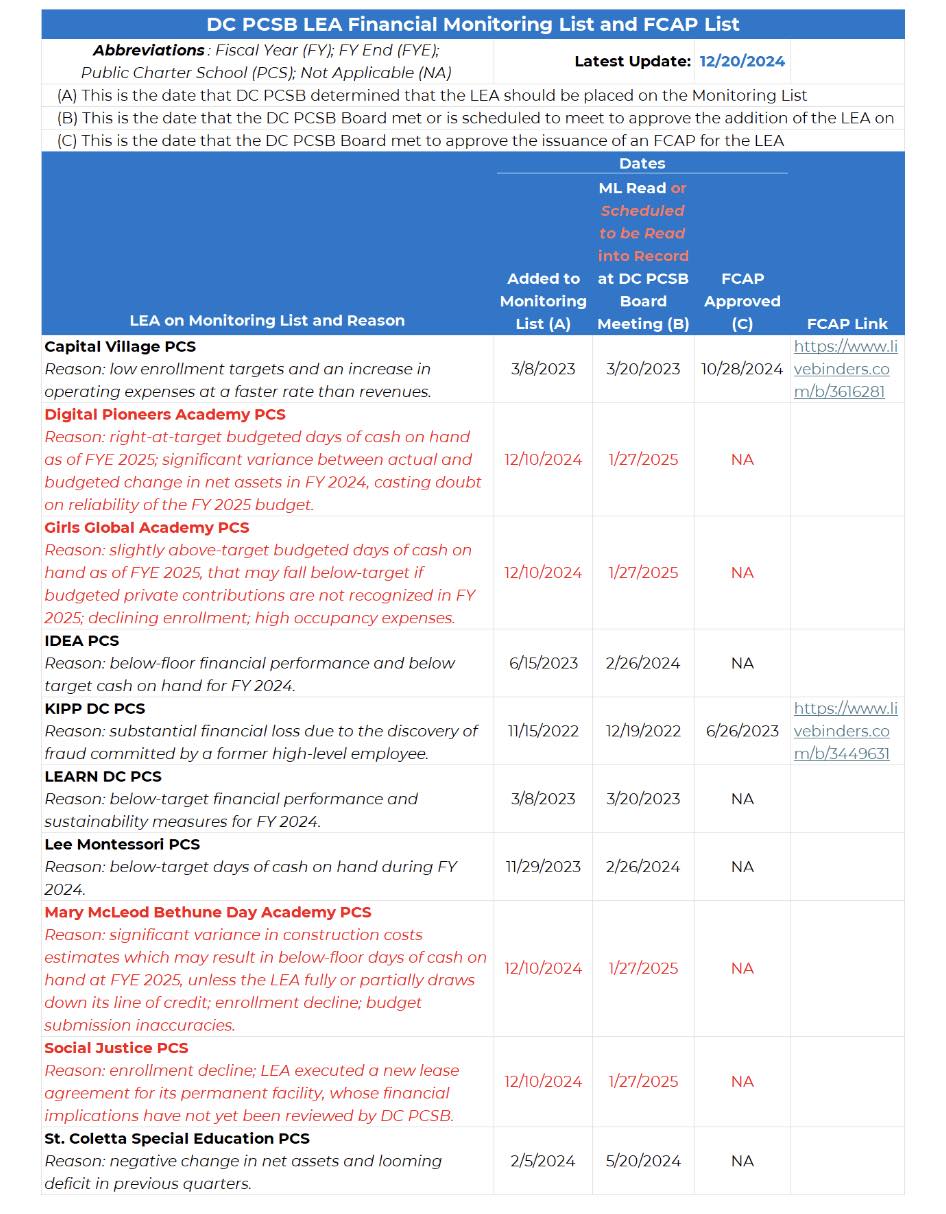
When I was able to last check the materials for the consent calendar for the 1/27/25 board meeting, a few days before this blog post, there was no note anywhere to indicate when this swapping out was done; why; or what the changes are. Today, I am unable to access this memo at all in the 1/27/25 board materials directly; I saved the URL, in the credit line above, so you can link to it–but accessing it from the board meeting materials is nonfunctional for me as of this blog post.
Regardless, my guess is that this swapping out of charts took place sometime after January 29, when I notified the DC council (and posted here) about the discrepancy between what was (supposedly) approved on January 27 by the charter board (i.e. the 12/20/24 chart with Rocketship on it) and a chart dated 12/20/24 provided to the council the next day (January 28) as a response to council questions.
Notably, that chart provided on January 28 does NOT list Rocketship:
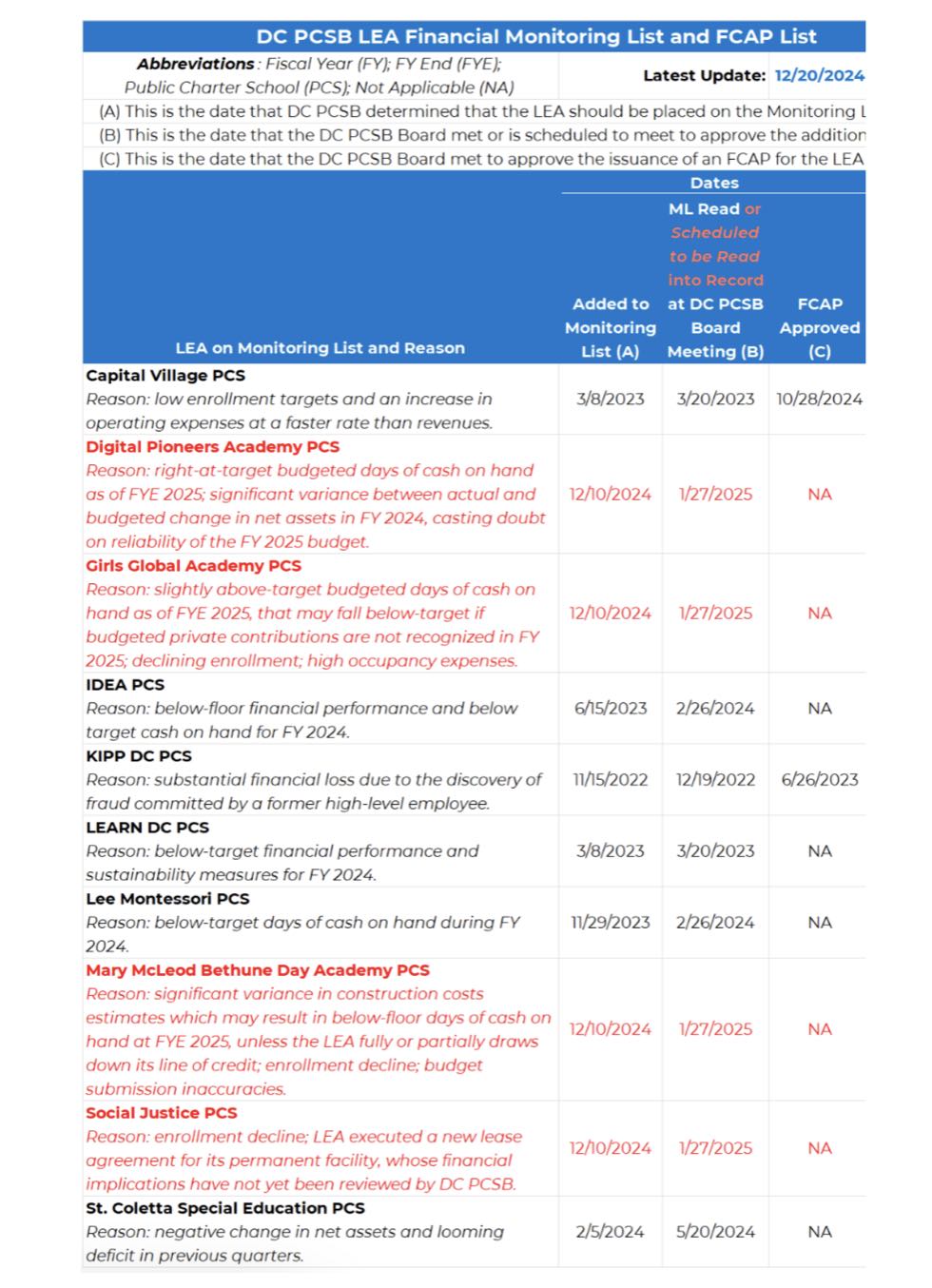
Setting aside the fact that we do not know for certain which version of the 12/20/24 chart the charter board actually voted on during its January 27, 2025 meeting (possibly, board members don’t know either!), in none of the three versions of this 12/20/24 chart do we know why the (4 or 5) schools were added to it on December 10.
Specifically, what happened on December 10 to have precipitated the (4 or 5) additions to this list after December 6? The charter board’s finance committee met on December 19, 2024—not December 10. None of the finance committee’s meetings are public, so an answer to this question is probably not forthcoming from the committee. That’s not mentioning that those same (4 or 5) schools added on December 10 are listed as being read into the record at the 1/27/25 charter board meeting—which didn’t happen until more than a month after the date on the charts (12/20/24).
That seems to be taking forward-thinking into Hollywood territory—but the fantasy doesn’t stop there! Here is yet another chart, listing schools on the charter board’s fiscal monitoring list as of 1/27/25:
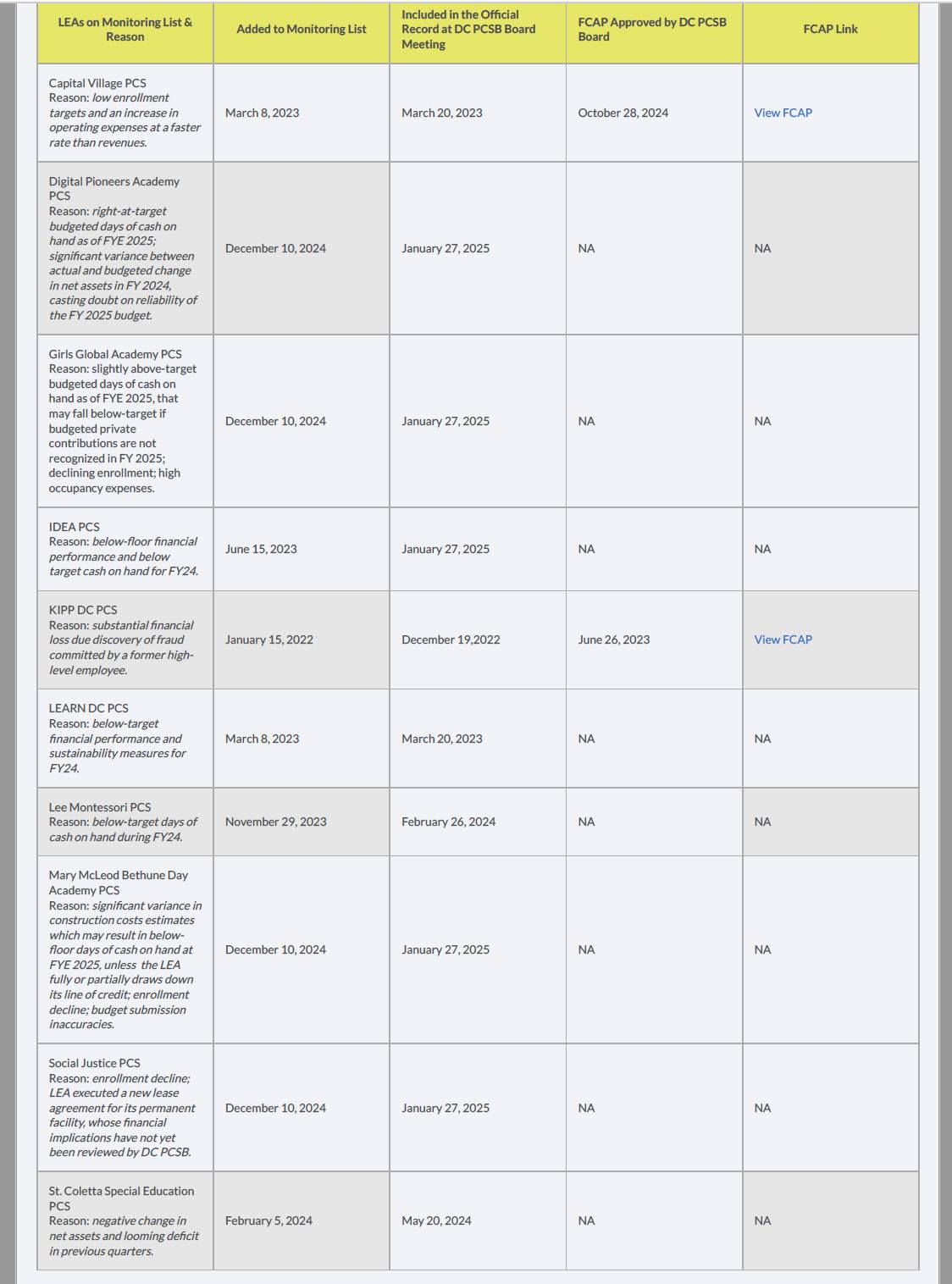
Now the chart above appears by way of a charter board website (https://dcpcsb.org/navigating-financial-oversight-schools-journey-monitoring-list) that is accessible ONLY when you look at the news items on the charter board’s website and select the one from December 6 (which contains the chart at the very top of this blog post). You can get to the chart immediately above, however, by clicking a link to another website embedded on the first website in this paragraph. AFAIK the website containing the chart immediately above is accessible to the public only via the first web page linked in this paragraph.
Clear as mud!
As you may have noticed, the three 12/20/24 fiscal monitoring charts posted above are not identical. And they appear blurry because the originals appear to be screenshots, not actual documents. Adding to the confusion is the fact that at some point Harmony was dropped from the fiscal monitoring list between December 6 and December 20. Presuming all is OK with Harmony now, is the charter board going to have a running tally? For instance, what if Harmony encounters rough fiscal waters again—and close in time to its departure from this list? And what of others recently departed from this list?
Clearly, we are not getting answers now—and given the charter board’s practices, probably never. I mean, how hard is it to have ONE chart with a running tally—and then highlight it on your website?
Yet as terrible as this is for DC, it is far worse for the families at those schools. After all, they and their children have to live with the consequences of the charter board playing shell games with their schools’ fiscal distress. Given that enrollment declines are likely for most DC schools because of declines in student population (not to mention that we now have Nazis defunding our publicly funded schools), that fiscal distress will only increase.
So let us look at what such shell games mean for a couple of the schools on the 12/20/24 list(s).
Bethune
In an undated document, the Mary McLeod Bethune charter school applied with the charter board sometime in late 2023 to have a new facility at 635 Aspen Street NW, not far from its current Ward 4 facility in a church at 5413 16th Street NW.
Bethune’s application was discussed at the January 2024 charter board meeting, where concerns were raised by community members regarding traffic; recruitment; siting; and community involvement in decision making and planning. Additionally, charter board member Shantelle Wright worried through the (acknowledged) new costs associated with renovating Bethune’s new space.
But the charter board memo about the application noted none of that. Instead, it was upbeat about the increased expenses of the new, larger facility, noting that Bethune’s enrollment had grown that year—without specifying how much. But as I noted in my testimony about this to the charter board, there were lots of fiscal red flags:
–For years, Bethune’s enrollment had declined, starting before the pandemic.
–At the time of this application, the charter board’s most recent fiscal analysis report (FAR) noted on pp. 131-32 that Bethune had to “increase its enrollment and/or effectively manage its costs to maintain its financial health.”
–The school itself recognized that growing enrollment was a solution to its fiscal woes in a 2022 application for another Ward 4 facility.
–Both that charter board FAR linked above and the LEA’s concurrent fiscal audit showed occupancy expenses of $1.558M. That fiscal audit also noted that Bethune’s rent was $539K–while the school’s FY22 annual budget said rent was $493K, and its SY21-22 annual report said that rent was $725K. So there was considerable cloudiness around Bethune’s rent for one school year in the same facilities and locations. Was it $539K? $439K? $725K? And how could anyone square any of that with the school’s reported occupancy expenses?
Because of the strong outcry from the community about this new facility, the charter board asked the school to work with the community and took up the application again at its March 2024 meeting. Yet despite a promise for a memorandum of understanding with the community, the school did not bring it forth as a finished product—and the charter board (after noting that such a memo was not required) approved the relocation. Board member James Sandman was alone in voting “no” because of the charter board’s requirement to give great weight to ANCs—and the local ANC had repeatedly expressed serious concerns.
Nearly a year later, Bethune has apparently not yet moved. On December 10, 2024, when Bethune was added to the schools on the fiscal monitoring list, the charter board had this write-up:
“Significant variance in construction costs [sic] estimates which may result in below-floor days of cash on hand at FYE 2025, unless the LEA fully or partially draws down its line of credit; enrollment decline; budget submission inaccuracies.”
Whether Bethune pulls out from its fiscal hole now is an open question—but no one can say that charter board members were not warned about this precise scenario. It is also an open question about what putting Bethune on the list now achieves that could not have been better achieved much earlier for everyone involved.
Remember, the charter board has never made its fiscal monitoring lists easily accessible. Changes after December 5, 2024 have made those lists only marginally less burdensome to access. As a result, what Bethune parents specifically know of any of this may be very limited. Bethune itself did not openly advertise when its board was meeting this school year until a few weeks ago (after I reported it to the office of open government). As it is, the last Bethune board minutes currently posted on its website—from August 2024—say nothing about any of this and mention no parents being present. The school does have a webpage about the move—but all the information is at least a year out of date as of this blog post.
Who (or what) this all serves is an open question—but clearly it is not Bethune families.
Social Justice
Social Justice applied with the charter board in April 2024 to change its location temporarily to modular units at 333 Kennedy Street NE (square and lot 3765 0811). The rationale was that its lease at Rocketship’s facility in Ward 5 was expiring in August 2024, so it would need this temporary space for SY24-25 and even SY25-26 until it moved into a permanent facility of its own.
Fair enough—except Social Justice’s application didn’t actually say all that. Instead, I gleaned this information from the May 2024 board memo on that application. That May 2024 board memo also noted that the modular classrooms would be in use while the school would renovate an existing, vacant building at the same site, to become its permanent facility. Fascinatingly, a footnote in the 5/24 board memo said the following about that existing, vacant building (boldface mine):
“The address . . . is 5455 3rd Street NE; however, it is located on the same premises as 333 Kennedy Street NE. The terms of the lease agreement for 5455 3rd Street NE are forthcoming. The school must amend its charter agreement before serving students at any new address. This proposal focuses on approval for the temporary modular units at 333 Kennedy Street NE.”
Neither the May board memo nor the board memo from June 2024, which also advocated approval of Social Justice’s proposal, indicated any serious fiscal concerns with the school—and its proposal was approved at the June 2024 charter board meeting.
Fast forward to August 12, 2024 and another application from Social Justice—this time, for space at a church at 5335 1st Place NE. This application hints that the modular spaces at 333 Kennedy NE (approved weeks before by the charter board) would not be ready in time for the SY24-25 school year. A week later, the charter board not only presented a board memo that supported Social Justice’s proposal, but also voted to approve it.
That quick turn-around was because school was slated to start a week after that charter board vote. But that 8/24 charter board memo was silent on the matter of a permanent facility at 5455 3rd St. NE for Social Justice. That possible future facility would figure a few months later, however, as Social Justice was added to the charter board’s fiscal monitoring list on December 10. The reason for that listing was not only “enrollment decline” but also that (boldface mine) “the LEA executed a new lease agreement for its permanent facility whose financial implications have not yet been reviewed by DC PCSB.”
Let us unpack this for a moment:
The charter board knew in May 2024 that Social Justice was unable to provide details about its future lease of 5455 3rd NE as a permanent home—yet knew that this facility was key to the school’s future footing, both physical and fiscal. Just a few months later, in August 2024, the charter board was presented with an emergency around a third facility for this same school in the same timeframe—yet did not appear to be even the least curious about what was happening with the lease for 5455 3rd NE, the school’s once and future permanent facility!
Then, in some relatively short time after that August 2024 board meeting, someone somewhere got worried about that lease—and the school ended up on the fiscal monitoring list.
So: Where is the lease for 5455 3rd St. NE? And what are its terms?
The latest posted minutes for Social Justice’s board, from 11/26/24, say the lease (presumably the one for 5455 3rd—but who knows?) was approved—but gave no details. The prior month’s board minutes for Social Justice noted the lease terms were “very favorable” (again, with no details). By December 2024, however, all of this devolved into an issue of fiscal concern for the charter board.
So it is that from spring 2024 on, Social Justice parents were told students would be in modulars in SY24-25—and then, weeks before the start of SY24-25, that the school would be at yet a different place temporarily. Then, weeks after that, the school found itself potentially in some fiscal straits because of a lease not presented publicly for yet another facility.
As with Bethune, it is not clear if families know that Social Justice is being monitored for fiscal issues. For one, the same people attended both the October and November board meetings for Social Justice, and the “guests” appeared to be authorized to speak about the lease. Maybe they are parents—but who knows? For another, if you are not invited to those board meetings specifically, you might find yourself wondering how to attend, as meeting dates are posted—but no times, locales, or links as of this blog post.
Again, who (or what) these practices are serving is unclear—but they are certainly not serving the families who have chosen that school.
None Of This Is Data
Nor is it new for DC’s charter sector.
Around 2017, the charter board sat for a year on information about fiscal distress at the WMST charter school. The building the charter owned—its only asset—was highly valuable to two entities: the school itself and the developer who had purchased most of that entire city block’s parcels for a major development. By the time the charter board acted on the school’s fiscal distress, the school’s only course of action was to sell its building. Perhaps unsurprisingly, the developer bought it for the price of the school’s outstanding debt—well below the building’s assessed value.
Similarly, Eagle Academy’s implosion occurred in front of the charter board for years running. Many members of the public testified about it, to no avail. But even after Eagle could not be ignored anymore (possibly because Eagle’s Nevada branch very publicly flamed out and there was robust Nevada reporting about it), the charter board still managed to hold close any information about DC charters’ fiscal distress.
For instance, at the December 5 hearing on Eagle, the council asked explicitly for a list of schools not meeting fiscal floors. On January 10, 2025, the charter board provided this document, with this chart:

Notice that there are no specifics on which schools are not meeting or exceeding fiscal floors and targets. Notice also that the number of schools not meeting those metrics is NOT small! For instance, at least 7 are not meeting the target for cash flow from operations margin nor the primary reserve ratio. In addition, there are 23 not meeting the target for enrollment variance.
Weeks later, on January 28, the charter board attempted to clarify with the council which specific schools it was referencing—and provided this table on p. 3 of its response document:
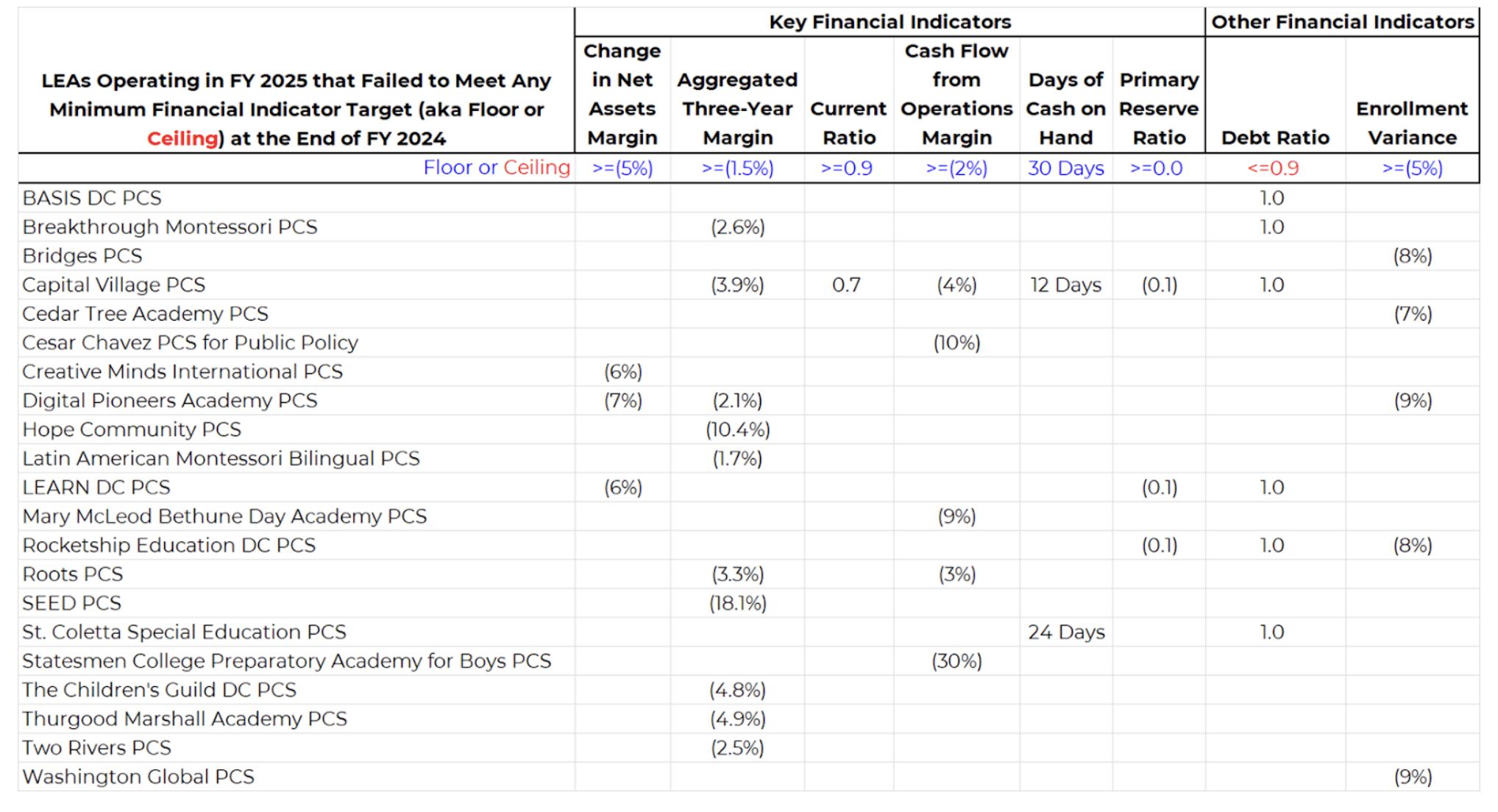
Perhaps the most salient issue here is that this table shows smaller numbers of charters not meeting specific floors/targets than the numbers mentioned in the January 10 table. Now, this smaller number of problematic fiscal issues/schools is not because things magically improved between January 10 and January 28!
It is because all of this is intentionally misleading.
Consider that SEED appears on the table above but not on the fiscal monitoring list. That is probably because SEED was issued a notice of fiscal concern at the October 2024 charter board meeting. But there is no list of such notices of fiscal concern—and no way to track which schools are on these lists over time, much less their connection to the fiscal monitoring lists.
In the end, none of this is data. The charts, the tables, the out-of-focus pictures, the cut-off margins, the percentages versus names, rationales, additions, omissions, blah blah blah: Utterly none of it is data. It is merely the appearance of data and the appearance of looking publicly responsive, without either data or responsiveness.
These are not the actions of an agency that centers the public in what it does. But these are the actions of an agency that has a lot to hide.
So here we go again (cue the cheesily scary organ music from an admittedly quainter time):
What exactly did the charter board approve on 1/27/25 for its most recent fiscal monitoring list?
What changed such that Rocketship was once on that list and then removed?
Will the charter board acknowledge that change publicly?
What significance does the date of December 10, 2024 have for the charter board fiscal monitoring list?
Why do the latest fiscal monitoring charts bear a date of December 20, 2024 when it is clear that items on them changed after that date?
Why are there different public versions of these 12/20/24 charts—and why do they appear to be screenshots?
Will the charter board acknowledge that its analysis of Bethune’s fiscal strength (ahead of approving Bethune’s new location) was wrong?
Where is the lease for Social Justice’s permanent facility, which is presumably causing the charter board concern over the school’s fiscal status—and when will the public see it?
Will the charter board make public all notices of fiscal concern in one place—and in relation to fiscal monitoring lists?
Will the charter board ever have a running tally of schools on its fiscal monitoring list?
Will we ever have a running tally of LEAs currently not meeting the target for cash flow from operations margin; primary reserve ratio; enrollment variance; and other key financial indicators?
Will the fiscal monitoring lists be prominently displayed on the charter board website?
 educationdc